Stones
Pyrite
It has been called fool's gold since the nineteenth-century gold rushes. Three tests, none of which needs equipment, are nonetheless enough never to be caught by it.
Updated September 8, 2026
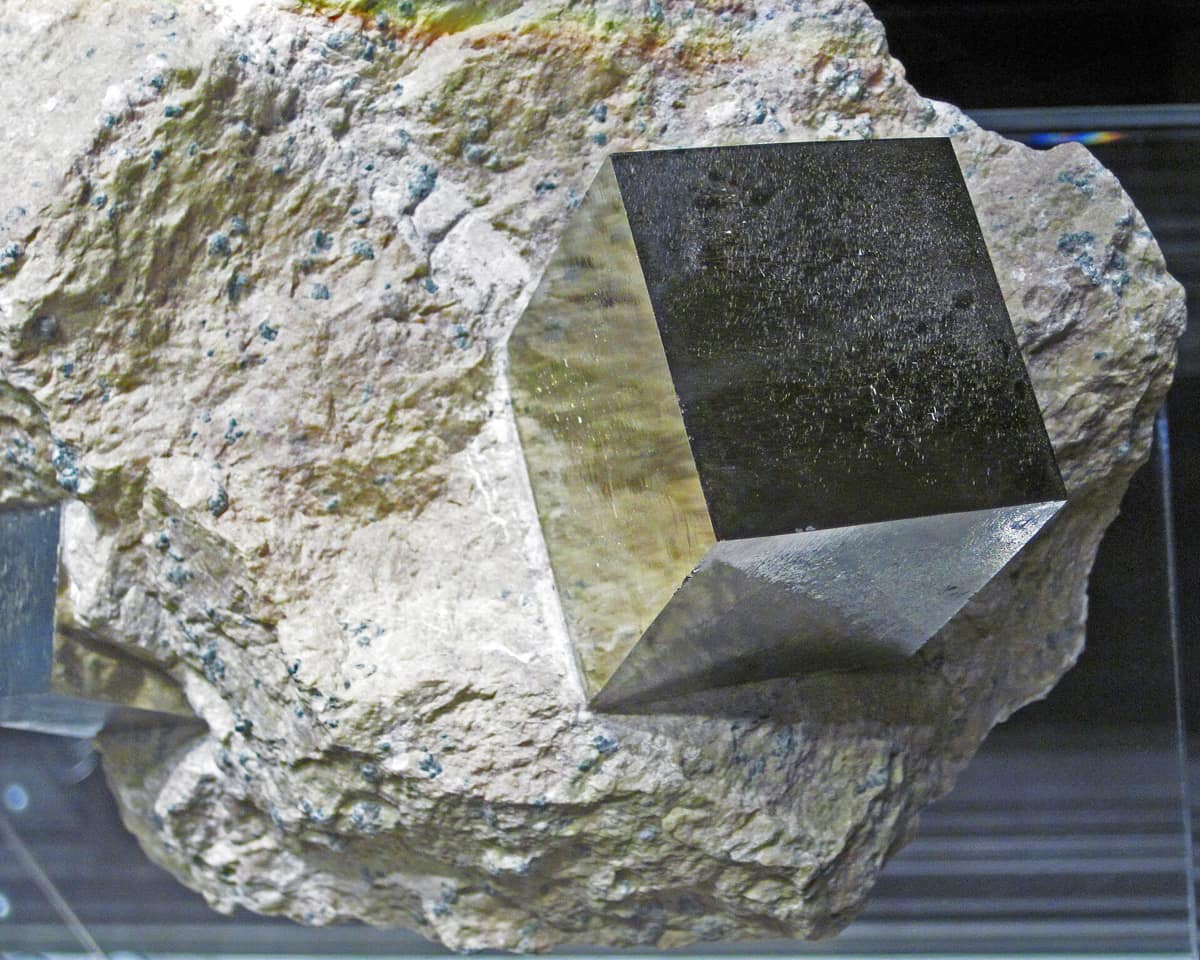
Pyrite is iron disulphide, FeS₂, and one of the most widespread minerals in the Earth's crust. It occurs in nearly every geological setting: hydrothermal veins, sedimentary rocks, coals, black shales, and in fossils it has replaced atom by atom.
Its name comes from the Greek pyr, fire: struck against flint it throws sparks. That is how fire was lit before steel, and it is also why it turns up on so many archaeological sites.
Its identity card
| Property | Value |
|---|---|
| Composition | iron disulphide, FeS₂ |
| Hardness | 6 to 6.5 |
| Density | 5.0 |
| Lustre | metallic |
| Colour | brass yellow, sometimes tarnished to iridescent brown |
| Streak | greenish black |
| Cleavage | very indistinct |
| Fracture | uneven to conchoidal, brittle |
| System | cubic |
What gives it away at first glance
The striations on the faces. This is the most characteristic detail, and the most overlooked. The faces of a pyrite cube carry fine parallel grooves — and on two adjacent faces those striations run perpendicular to each other. No imitation, and no other yellow mineral, does that.
The geometric shapes. Pyrite crystallises as perfect cubes, as octahedra, or as pyritohedra — a solid with twelve pentagonal faces. Finding a metallic cube with right angles inside a rock is nearly a certainty on its own.
The brittleness. Pyrite is brittle. A blow chips it and breaks it into angular fragments. That is the exact opposite of gold.
Pyrite or gold: the three tests
| Test | Pyrite | Gold |
|---|---|---|
| Hardness | 6 to 6.5, scratches glass | 2.5 to 3, scratched by a copper coin |
| Under a hammer | chips, shatters | flattens, cuts with a knife |
| Streak on porcelain | greenish black | bright yellow |
| Density | 5.0 | 19.3 |
| Face appearance | striated, geometric | smooth, rounded, without edges |
The streak test is the quickest and the most decisive: one stroke on the back of a ceramic tile and the question is closed. The density difference is enormous too — gold is nearly four times heavier — which is obvious in the hand as soon as the samples are of comparable size, and it is what panning has always exploited.
The other confusions
Chalcopyrite. A copper-iron sulphide, more golden than pyrite, often covered in a blue-green iridescent tarnish. Markedly softer: hardness 3.5 to 4, a knife scratches it easily. It rarely forms good cubes and tends to occur as irregular masses.
Marcasite. Exactly the same chemical formula, a different crystal structure. Paler, greener, in needles or radiating nodules rather than cubes. It decays even faster than pyrite.
Yellow mica. In river sand, glittering flakes are almost always mica: they are flexible, they bend under a fingernail, and they float for a moment. Pyrite sinks at once.
Pyrite disease
This is the most important practical point for anyone keeping specimens, and the one nobody mentions before the sale.
With moisture and oxygen both present, pyrite oxidises. The iron and sulphur become sulphates, and sulphuric acid is released. The specimen grows a powdery whitish or yellowish coating, takes on a sulphurous smell, swells, then crumbles. In the end it reduces to dust.
The process is irreversible: it can be slowed, not reversed.
- Keep it dry. Air below 50% relative humidity is enough in most cases.
- Keep it apart. The acid attacks labels, cardboard boxes and neighbouring minerals — carbonates especially.
- Do not shut it in with paper. Cardboard and paper absorb moisture and give it back.
- Do not wash it. Water accelerates everything.
The most stable pieces are large, compact, well-formed crystals; the most fragile are finely crystallised pyrite, pyritised fossils, and nodules from black shales.
Where it comes from
Everywhere. In metal-bearing veins, in spoil heaps and mine dumps, in shales and marls, in nodules within clay cliffs, and as golden pyritised ammonites — magnificent, and particularly prone to the disease described above.
Frequently asked questions
How do I tell pyrite from gold?
By hardness, fracture and streak. Pyrite scratches glass (6 to 6.5); gold takes a scratch from a copper coin (2.5 to 3). Struck, pyrite chips and shatters; gold, being malleable, flattens and can be cut with a knife. And the streak on porcelain is greenish black for pyrite, bright yellow for gold.
Is pyrite worth anything?
Very little as a material: it is extremely common. A well-formed cubic crystal, especially the ones from Navajún in Spain, has real collector value — which rests on the perfection of its geometry, not on the metal in it.
Why is my pyrite crumbling?
That is pyrite disease. In the presence of moisture and oxygen, iron sulphide oxidises to sulphates and releases sulphuric acid: the specimen swells, grows a whitish or yellow powder, then falls apart. The process is irreversible. Keep pyrite dry, away from other minerals, and never in a closed box with cardboard or paper, which the acid attacks.