Guides
How to identify a rock
A stone picked up on a walk is not named at a glance. It is named by eliminating, test after test, everything it is not — and most of those tests fit on a kitchen table.
Updated September 8, 2026
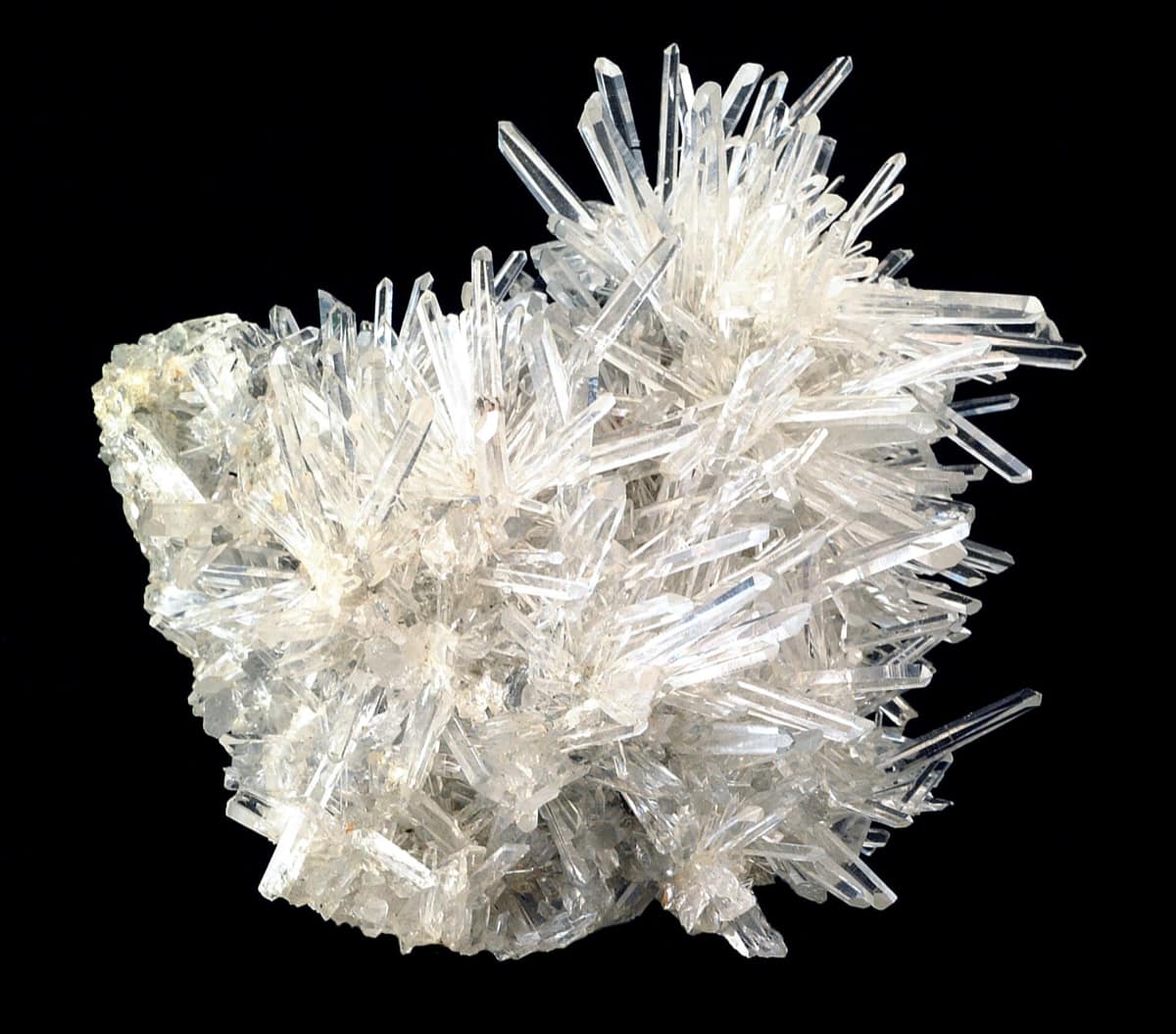
There is no glance that names a stone. Faced with a grey pebble, an experienced geologist starts exactly where you do: looking, weighing it in the hand, scratching. The difference is that they know the order, and above all what each test rules out.
That is the point most guides miss. Identifying is not getting the name right first time, it is shortening a list. A translucent purple stone might be amethyst, fluorite, glass, or dyed quartz. One test — hardness — removes three of them. The rest follows.
Here is that list of tests, in the order that eliminates the most.
Start by looking, not by testing
Before you scratch anything, note five things. They cost nothing and they steer everything that follows.
- The shape. Flat faces and sharp angles? You are holding a crystal, and its geometry is already a strong clue. A shapeless mass? Possibly a fragment, a tumbled pebble, or a mineral that almost never grows good individual crystals.
- The transparency. Transparent, translucent (light passes but no image forms), or genuinely opaque. Look especially at thin edges: many stones that seem opaque let light through along a ridge.
- The texture. Grainy, like sugar? Glassy and smooth? Fibrous? Layered?
- The uniformity. One single substance, or several grains of different colours packed together? That is already the rock-or-mineral question, which comes back below.
- The context. Where did you pick it up? A chalk beach, an alpine torrent and a colliery spoil heap do not produce the same stones. It is the clue nobody can give you remotely, and often the most decisive of all.
Colour is the worst clue there is
It is counter-intuitive, and it is nonetheless the first thing to unlearn: colour is the least reliable property a mineral has.
Quartz alone makes the case. Colourless, it is rock crystal; purple, amethyst; yellow, citrine; pink, rose quartz; brown to black, smoky quartz or morion. One mineral species, six names, six colours — and each time a few atoms of impurity, or a dose of natural radiation, for the whole difference.
The reverse holds too. "A purple stone" can be amethyst (hardness 7), fluorite (hardness 4), charoite, coloured glass, or heated quartz. Colour groups them; everything else separates them.
Treat colour as a starting point, never as a conclusion.
Lustre: the first real fork in the road
Lustre is the way a surface returns light. It splits the mineral world in two, and it is the sharpest division there is.
Metallic lustre: the stone shines like polished metal and is opaque, even on a thin edge. Pyrite, galena, haematite, magnetite. That family is small — a few dozen common species — and you have just set aside everything else.
Non-metallic lustre: everything else, described by comparison.
| Lustre | Looks like | Examples |
|---|---|---|
| Vitreous | broken glass | quartz, amethyst, tourmaline |
| Pearly | the inside of a shell | mica, gypsum, talc |
| Silky | parallel fibres | fibrous gypsum, asbestos |
| Resinous | resin, set honey | amber, sphalerite |
| Greasy | an oiled surface | nephrite, some massive quartz |
| Earthy or dull | dry chalk | kaolin, limonite, chalk |
A common trap: a dirty or weathered stone looks dull when it is in fact vitreous. Rinse it, and chip a small corner if you can — lustre is judged on a fresh surface.
Hardness: the test that rules out the most
This is the king of tests. It is quick, it needs almost nothing, and it settles pairs the eye will never separate.
A mineral's hardness is measured on the Mohs scale, which runs from 1 (talc, scratched by a fingernail) to 10 (diamond). The principle is purely relative: if A scratches B, A is harder than B.
You do not need a mineralogist's kit. A few ordinary objects will do:
| Object | Approximate hardness |
|---|---|
| Fingernail | 2.5 |
| Copper coin | 3 to 3.5 |
| Steel nail or knife blade | 5.5 |
| Shard of glass | 5.5 |
| Unglazed porcelain plate | 6.5 to 7 |
| Hardened steel file | 6.5 |
Two precautions, without which the test lies.
Scratch, then rub the mark with a finger. A soft metal leaves a grey streak on a hard stone that looks a great deal like a scratch and wipes off. A real scratch is a groove cut into the stone: it stays.
Be careful with modern coins. Most small "copper" coins — euro cents included — are copper-plated steel. The plating scratches at about 3, but if your test cuts through to the steel core you are suddenly testing at 5.5 without knowing it. Use an old solid-copper coin, or none at all.
Always test on an inconspicuous spot, and in both directions: does the stone scratch the glass, and does the glass scratch the stone.
Streak: the colour that does not lie
Drag the stone across a plate of unglazed porcelain — the back of a bathroom tile works perfectly. The powder it leaves is the streak, and its colour is far more constant than that of the whole mineral.
This is the test that unmasks haematite. A block of haematite can be black, steel grey, or brick red; its streak is always red-brown. Pyrite, brass-yellow like gold, leaves a greenish-black streak. Magnetite, black, leaves a black streak.
One gesture, and a whole family of confusions falls away. The detail is in the guide to the streak test.
One limit worth knowing: the plate has a hardness of about 6.5. A mineral harder than that will leave no powder — it will scratch the plate instead. Quartz, topaz and corundum have no usable streak, and that absence is itself information.
Weight: judge by hand before you weigh
Take the stone in one hand and an ordinary pebble of similar size in the other. Most common rocks sit around 2.6 to 2.8 times the density of water, and your hand is very well calibrated to that value: it notices immediately what falls outside it.
A stone clearly too heavy for its size points to a metallic mineral or one rich in heavy metals: haematite (5.3), pyrite (5.0), magnetite (5.2), barite (4.5), galena (7.6). A surprisingly light stone suggests a vesicular volcanic rock — pumice floats — or jet, or amber.
For a number rather than an impression, weigh the stone dry, then suspended in water. The density is the dry weight divided by the difference between the two. A kitchen scale and a glass are enough, provided the stone is big enough for the measurement error to stay small.
Fracture or cleavage
Look at how the stone has broken. It is a property of the atomic structure, and it does not dress itself up.
Cleavage is a break along clean planes, which return light like small mirrors, often repeated in steps. Calcite cleaves into rhombohedra, galena into cubes, mica into sheets thin enough to lift with a fingernail, fluorite into octahedra.
Fracture is a break with no preferred plane. The most recognisable is conchoidal fracture: a smooth curved surface, shell-like, as in a windscreen impact. Quartz does it, flint does it, obsidian does it beautifully — and it is precisely that property that had all three worked into tools for two million years.
Vinegar, for the carbonates
Put a drop of white vinegar on a fresh edge. If it foams and fizzes, you are holding a carbonate: limestone, calcite, chalk, marble.
The test is decisive, and it removes a whole family of very common sedimentary rocks in one go. Two useful qualifications:
- Dolomite barely reacts as a solid block. Scrape a little material into powder: the powder will fizz.
- Vinegar is a weak acid. The reaction is slower and quieter than with the dilute hydrochloric acid used in laboratories. Look closely, and listen: the fizz is often audible before it is visible.
Rock or mineral?
The question is worth asking early, because it changes the kind of answer you are looking for.
A mineral is a natural substance with a defined chemical composition and an ordered crystal structure. Quartz, calcite and pyrite are minerals. They have a name, a formula, and measurable physical properties — everything the tests above interrogate.
A rock is an assembly of minerals. Granite is a visible mixture of translucent grey quartz, pink or white feldspar, and glittering black mica. No single hardness test means anything on granite: you would be measuring whichever grain you happened to hit.
In practice, use a loupe, or simply look closely in daylight. Several kinds of grain, of different colours and lustres, packed together? It is a rock, and what you then need to recognise is an assembly and a texture rather than a species. A substance uniform all the way through the break? It is a mineral, or a rock too fine-grained to resolve by eye — a basalt, a flint, a mudstone.
Putting the clues together
Take an example. A dark grey pebble picked up on a Channel beach. It is smooth, translucent at the thin edges, with a chalky white crust in places.
- Non-metallic lustre, rather greasy. The metallic family is out.
- It scratches glass decisively, and the porcelain plate barely marks it. Hardness around 7. Calcite (3), fluorite (4) and limestone are out.
- No usable streak: it is harder than the plate. Consistent.
- Vinegar does nothing — but the white crust fizzes.
- A chipped corner shows a curved, smooth, shell-like break. Conchoidal.
- Context: a Channel beach, chalk cliffs behind it.
Hardness 7, conchoidal fracture, chalk crust, chalk coastline: this is flint. None of the six clues was sufficient alone; together they leave one answer. The white crust in particular is the cortex — the trace of the chalk the nodule grew in.
That is exactly how a stone gets identified: not by recognising it, but by closing in on it.
What the app does with all this
Geode starts from the photograph, which is to say from the observable half of the method: colour, lustre, shape, texture, the look of a broken surface. That is enough to bring the field down to three or four plausible candidates, and that is what it hands back — named, explained, with what argues for each.
Then it does what no photograph can do alone: it asks you for a test. The one that separates the remaining candidates, and only that one. Does it scratch glass? Does the vinegar foam? You are holding the stone, you are the only one who can answer — and your answer eliminates, exactly as in the method above.
The result is still an indicative identification: it points, it explains, it does not replace laboratory work. But it walks you through the right procedure, which is already most of what separates a name found from a name guessed.
Frequently asked questions
Can a rock be identified from a photograph?
Partly. A photograph carries colour, lustre, crystal shape, the texture of a broken surface — enough to narrow the field to three or four candidates. It carries neither hardness, nor streak, nor density, and those are precisely the properties that separate the pairs people confuse. That is why Geode, once it has offered its candidates, asks you to run one specific test: the photograph asks the question, your hand settles it.
What is the difference between a rock and a mineral?
A mineral is a chemically defined substance with a crystal structure: quartz, calcite, pyrite. A rock is an assembly of minerals: granite is quartz, feldspar and mica together. Identifying a mineral means finding a name; identifying a rock means recognising an assembly, and usually the way it formed.
Do I need equipment to identify a rock?
A piece of unglazed porcelain, a steel nail, a shard of glass and some white vinegar cover the great majority of cases. The unglazed back of a bathroom tile makes an excellent streak plate and costs almost nothing.
Could a stone found in a garden be worth anything?
Rarely, and it is worth knowing that before paying for an appraisal. The overwhelming majority of stones people pick up are quartz, flint, limestone, granite or basalt — common everywhere, and worth nothing on a market. Which makes them no less interesting: they tell you the geology of the place you found them.