Stones
Obsidian
Obsidian is not a mineral: it is lava that cooled too fast to crystallise. A natural glass, and the only material that takes an edge finer than a steel scalpel.
Updated September 8, 2026
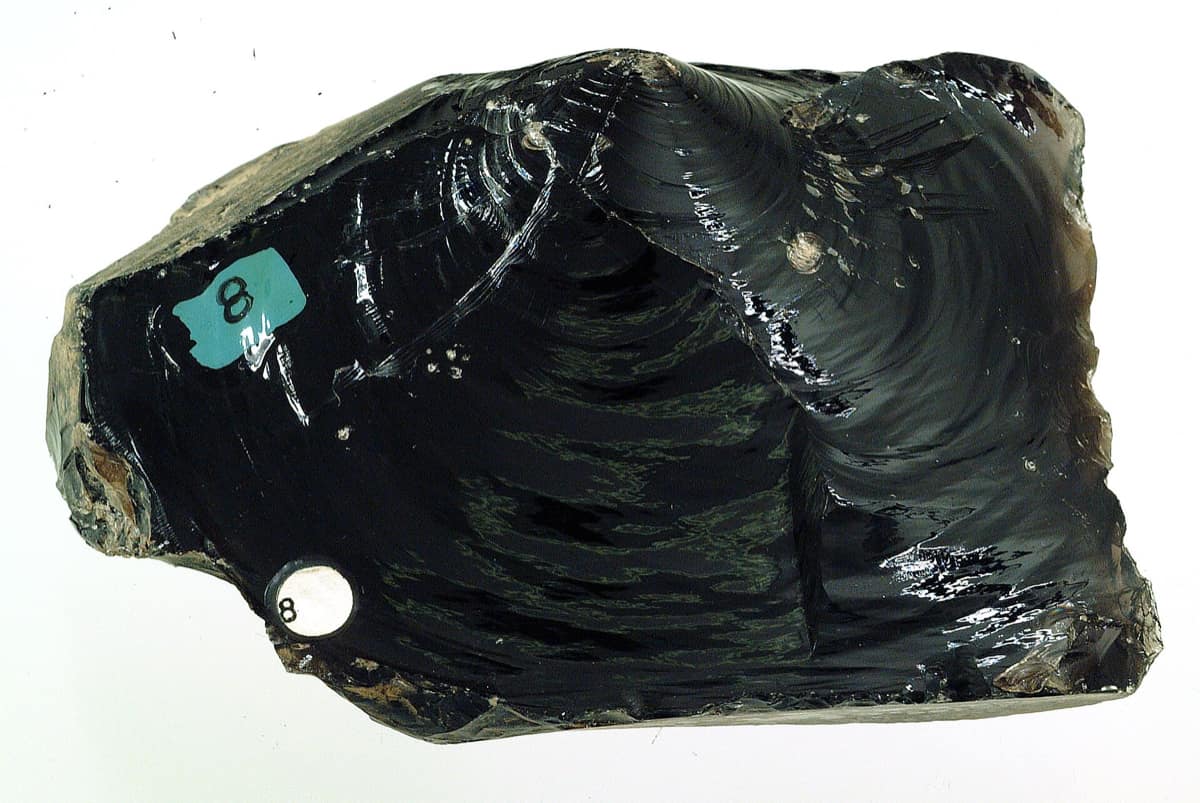
Obsidian is a volcanic rock, and yet it has no crystal structure at all. When a silica-rich lava — viscous, low in water — cools too fast for its atoms to order themselves, they freeze in disorder. The result is a glass, in the strict sense of the word.
That is why mineralogists class it among the mineraloids: it has a composition, it has no crystal lattice. So it has no cleavage, no faces, and no shape of its own.
Its identity card
| Property | Value |
|---|---|
| Nature | volcanic glass, amorphous |
| Composition | 70 to 75% silica, like a granite |
| Hardness | 5 to 5.5 |
| Density | 2.35 to 2.6 |
| Lustre | vitreous, often very bright |
| Fracture | conchoidal, perfect |
| Streak | white |
| Transparency | translucent at thin edges |
The three signs that name it
It is translucent at the edges. This is the decisive test, and it costs nothing. Hold a ridge up to a window: obsidian lets a brown, green or grey glow through. A black stone that stays opaque to the edge is something else — basalt, haematite, tourmaline. See the guide to black stones.
The fracture is shell-like. Curved, smooth, concentric surfaces, like a stone's impact in a windscreen. That is conchoidal fracture, and obsidian produces it better than any other rock. It is also what made its career: it flakes entirely predictably, which made it the tool material of choice from prehistory onwards.
It has no internal structure. No grains, no banding, no visible crystals. One homogeneous material, edge to core.
The varieties
Snowflake obsidian. Rounded white or grey patches in the black: these are spherulites of cristobalite, crystals that began to form in the glass over time. It is devitrification caught in the act.
Mahogany obsidian. Streaked red-brown zones, from oxidised iron.
Sheen or rainbow obsidian. Silky or iridescent reflections, produced by aligned inclusions or microbubbles that diffract light. The effect only shows at certain angles.
Apache tears. Rounded translucent nodules, usually held in a pale weathered rock — perlite. The name comes from a nineteenth-century Arizona legend.
The confusions, and how to clear them
Manufactured glass. This is the hardest one, because the two materials are physically the same kind of thing. Look for what a manufactured object keeps: an even thickness, a bottle's curvature, a moulding line, a marked base, numerous well-rounded spherical bubbles. A decidedly green or beer-brown tint is suspicious too. Natural obsidian has irregular angular shapes with no symmetry at all.
Clinker. Glassy, black, sharp — and bubbly. It is abundant anywhere coal has been burnt in quantity, which in Europe means very nearly everywhere. Stretched bubbles and a poured-material look give it away.
Black tourmaline. Much harder (7 to 7.5), in elongated prisms striated lengthwise, opaque. No conchoidal fracture.
Jet. Far lighter, softer, warm to the touch, brown streak. It nearly floats.
Glassy basalt. Basaltic lava quenched in water gives a dark glass, but an opaque one, full of bubbles and considerably heavier.
An edge out of the ordinary
Because it has no grain, obsidian breaks without meeting an obstacle. A fresh edge can terminate at a thickness of a few nanometres — an order of magnitude below what sharpened steel can reach, because steel always ends up limited by the size of its own crystals.
This is applied mineralogy: obsidian blades are still used in fine surgery and in electron microscopy for exactly that reason. And it is also why fresh flakes deserve the respect you would give broken glass.
Where it comes from
Only in recent volcanic terrain, and that is an identification point in its own right: glass is unstable on geological timescales and always ends up crystallising. There is no ancient obsidian — beyond a few tens of millions of years, all of it has devitrified.
The classic sources are Iceland, Lipari near Sicily, Milos in Greece, Anatolia, Mexico, the American West and the Andes. There is no workable deposit in mainland France or Britain: an "obsidian" picked up in either place deserves a careful second look.
Frequently asked questions
How do I recognise real obsidian?
Hold a thin edge to the light: obsidian is translucent, a very dark brown or green, never fully opaque. Look for conchoidal fracture, in smooth curved shells. It scratches glass only with difficulty and is scratched by it: both are glasses, of similar hardness.
What is the difference between obsidian and clinker?
The bubbles. Clinker, the vitrified residue of burnt coal, is riddled with them, often irregular and stretched. Natural obsidian is massive and homogeneous. Context matters too: clinker turns up on former industrial sites and along railway lines, obsidian only in recent volcanic terrain.
Is obsidian dangerous to handle?
Its fresh edges are, yes. An obsidian break can terminate in a single row of atoms, which makes it the finest cutting edge any natural material can produce — finer than surgical steel. Handle fresh flakes as you would broken glass, and store them away from other specimens.