Stones
Agate
An agate is the cast of a bubble. Lava left a cavity, silica-bearing water lined it layer by layer, and every band is one episode of that filling.
Updated September 8, 2026
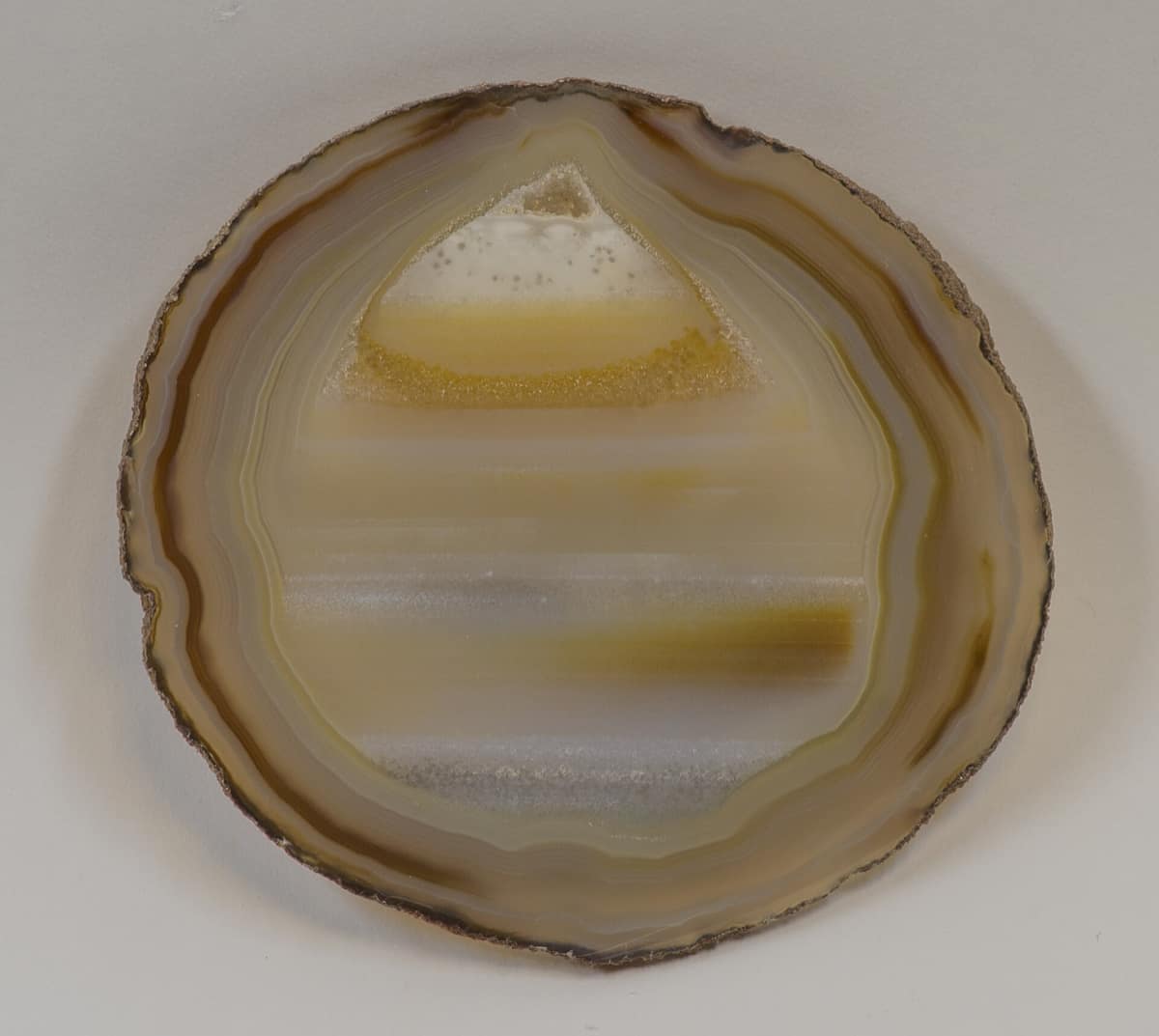
An agate is not a distinct mineral: it is chalcedony, quartz in crystals so small that no optical microscope resolves them, arranged as fibres. What makes it an agate is the arrangement: successive concentric bands, each laid down by a different pulse of silica-bearing water.
It forms in the cavities left by gas in a lava flow. The bubble empties, the rock cools, and over millions of years silica-charged water seeps in and lines the wall, layer after layer. Read the bands from the outside inwards: you are reading the chronological order of the filling.
Its identity card
| Property | Value |
|---|---|
| Composition | silicon dioxide, SiO₂ (chalcedony) |
| Hardness | 6.5 to 7 |
| Density | 2.58 to 2.64 |
| Lustre | waxy to vitreous |
| Transparency | translucent |
| Cleavage | none |
| Fracture | conchoidal |
| Streak | white |
How to recognise it
The bands follow the outline. This is the sign that separates it from everything else. The ribbons hug the shape of the original cavity, in nested concentric rings. On so-called "fortification" agates the bands turn sharp angles that recall the plan of a citadel seen from above.
It is translucent. Not transparent — translucent: light passes, no image forms. Wet a pebble or hold it in front of a lamp, and the bands appear even where the dry surface showed nothing.
The lustre is waxy. It is the microscopic fibrous texture that softens the reflection. Crystalline quartz shines like broken glass; an agate has a greasier, duller sheen.
It scratches glass. Hardness 7, like the whole quartz group. A steel nail does nothing to it.
Many agates have a hollow core lined with small quartz or amethyst points: the cavity never finished filling. That is a geode, and it is the same story told on the amethyst page.
The varieties
| Name | What defines it |
|---|---|
| Fortification agate | angular concentric bands, like a fortress plan |
| Uruguayan banded agate | horizontal, flat bands, settled by gravity |
| Onyx | straight parallel bands, black and white |
| Sard | red-brown chalcedony, often banded with white |
| Carnelian | orange to red chalcedony, translucent, unbanded |
| Moss agate | branching green or black inclusions, no bands |
| Dendritic agate | manganese oxide inclusions in fern shapes |
| Jasper | same family, but opaque |
Two useful remarks. Moss agate and dendritic agate are not banded at all: their names are commercial, and the "moss" is not a plant but branching mineral inclusions. And the boundary between agate and jasper is gradual — a single pebble can be translucent and zoned on one side, opaque and plain on the other.
Spotting a dyed agate
This is the most useful point in practice, because dyeing is enormously widespread and rarely declared on a market stall.
The process is old — it goes back to nineteenth-century Idar-Oberstein in Germany — and entirely legitimate: it exploits the fact that an agate's bands are not equally porous. The dye penetrates the permeable bands and ignores the others, which produces a very marked contrast.
What should raise an eyebrow:
- Electric blue, magenta, apple green, vivid purple, fuchsia. These colours do not occur in natural agates. A turquoise-blue polished slice is dyed, with no useful exception.
- Over-even saturation. Natural colours vary in intensity along a single band; a dye is uniform.
- Dye in the cracks. Look at the fractures: a stronger line underscores them.
- Too sharp a contrast between neighbouring bands, with no gradation.
Agate's natural colours are sober: white, grey, brown, red-brown, honey, orange, pale blue-grey, black. A genuinely bright blue agate exists, but it is rare and costs what rarity costs.
To be clear: a dyed agate is still an agate. The mineral is genuine, only the colour is not. It becomes a problem only when the price or the label claims otherwise.
Where it comes from
In old basalts and their erosion products. The great deposits are in Brazil (Rio Grande do Sul), Uruguay, India, Madagascar and Botswana. In Europe, Scotland, Germany (Idar-Oberstein), Poland and France supply them regularly.
On a beach or in a riverbed, tumbled agates are spotted by their wet translucency and their slightly waxy surface. The guide to beach pebbles explains how to look for them usefully, and why there is no point looking on a chalk coast.
Frequently asked questions
How do I recognise an agate?
By its concentric bands and its translucency. Wet the stone or hold it against the light: an agate lets light through and shows parallel ribbons following the outline of the stone. It scratches glass (hardness 7) and its lustre is waxy rather than sharply vitreous.
How can I tell whether an agate has been dyed?
By the colour. Electric blue, magenta, apple green and vivid purple do not occur in natural agates: those slices are dyed, and it is a common industrial process, practised since the nineteenth century and entirely legal. Look also for over-even saturation and dye pooled in cracks. The natural colours are white, grey, brown, red-brown, honey and blue-grey.
What is the difference between agate and jasper?
Both are chalcedony, which is to say microcrystalline quartz. Agate is translucent and banded; jasper is opaque, loaded with impurities — up to 20% — and usually plain or mottled rather than zoned. They often occur together, and a single sample can grade from one into the other.