Stones
Amethyst
Amethyst is quartz, purple. Everything that separates it from fluorite, from glass or from resin comes down to two tests you can run in thirty seconds.
Updated September 8, 2026
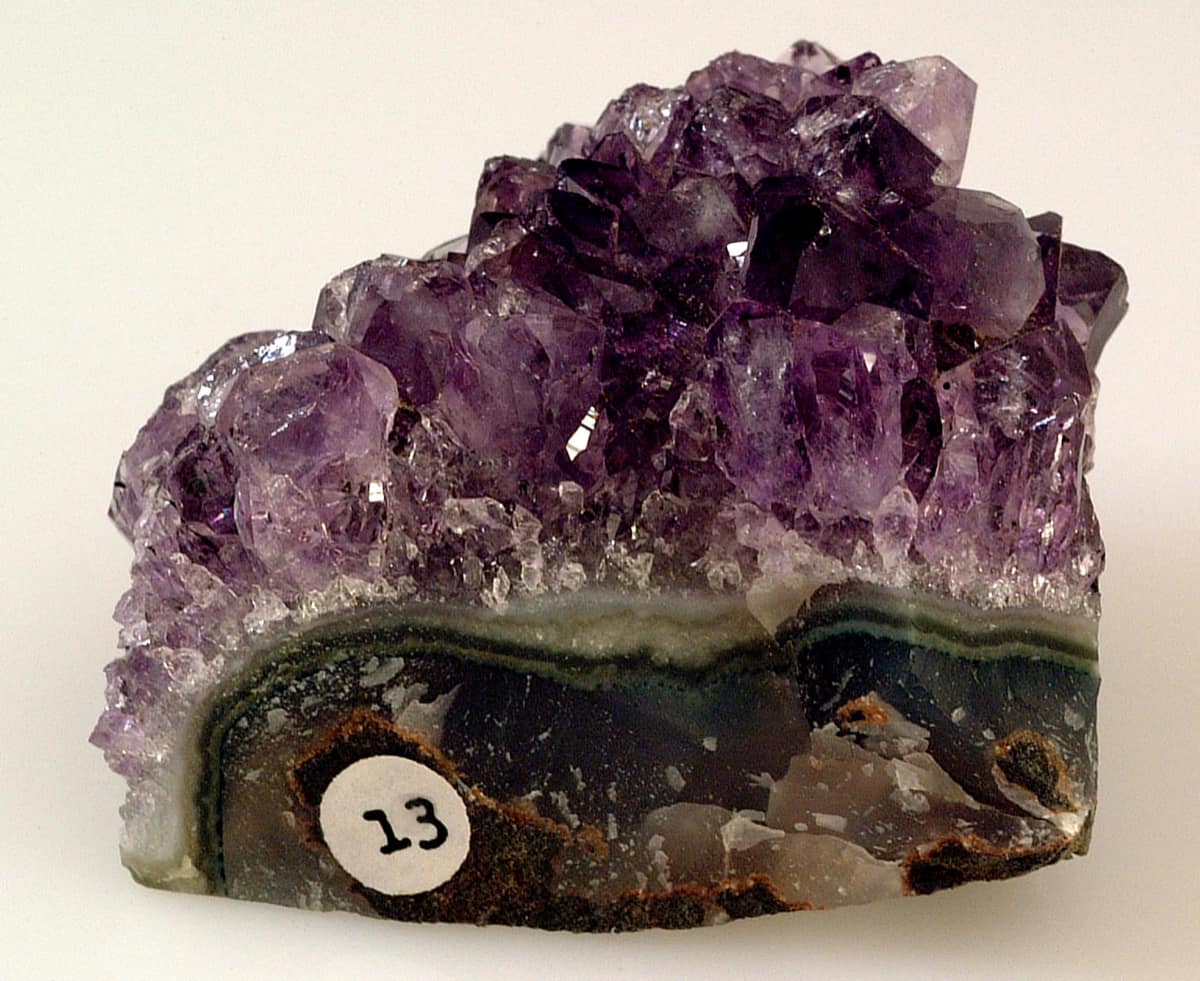
Amethyst is the purple variety of quartz. It is not a distinct mineral: same formula, same structure, same hardness as colourless rock crystal. What colours it is traces of iron that natural ground radiation has put into a particular state, and that difference comes down to a handful of atoms.
Which is why everything true of quartz is true of it — and why that is also how you recognise it.
Its identity card
| Property | Value |
|---|---|
| Composition | silicon dioxide, SiO₂ |
| Hardness | 7 |
| Density | 2.65 |
| Lustre | vitreous |
| Cleavage | none |
| Fracture | conchoidal |
| Streak | white |
| System | rhombohedral (trigonal) |
What it actually looks like
Amethyst purple runs from very pale lilac to deep violet, sometimes with red flashes. Two characters come up nearly every time:
The colour is uneven. This is the most reliable marker of all. Within a crystal the purple usually concentrates towards the tip and lightens towards the base; you often see angular chevron zones following the growth faces. A perfectly homogeneous purple stone should raise suspicion.
The crystals are six-sided prisms ending in a point. In a geode they stand packed side by side, showing only their tips — the classic amethyst image. In Alpine veins they grow isolated and well formed.
Amethyst does not cleave. Broken, it gives smooth curved shell-like surfaces: conchoidal fracture, the same as glass and flint.
The five confusions, and the test that settles each
Purple fluorite. Confusion number one, and it takes a second to resolve. Fluorite has a hardness of 4: a plain steel nail scratches it decisively, where the same nail slides off amethyst. It also has perfect octahedral cleavage — broken, it shows clean bright planes, often as small triangles, where amethyst shows curved shells. Its crystals are cubes, not pointed prisms.
Coloured glass. Glass sits at 5.5, amethyst at 7. Amethyst scratches glass; the reverse is not true. Look also for spherical bubbles, too-uniform colour, a moulding line — and trust the touch: quartz conducts heat away far better than glass, and stays cool for several seconds against a lip or a cheek.
Resin or plastic. Very low hardness, sometimes marked by a fingernail, obviously too light, and a hot point releases a smell. Far more frequent on tourist markets than people expect.
Dyed or irradiated quartz. Colourless or smoky quartz can be irradiated artificially to turn purple. Physically the result is amethyst — the distinction is commercial, not mineralogical, and it is invisible to the eye.
Synthetic amethyst. Grown in autoclaves since the 1970s, it has exactly the same composition, hardness and density. No field test separates it from the natural stone; that takes a gemmological laboratory reading the growth features. Any app claiming to settle it from a photograph is claiming something it cannot know.
Where it comes from
The great geodes come from the basalt flows of southern Brazil and Uruguay: degassing lava left cavities that silica-bearing water later lined, over millions of years. It is also found in Alpine fissures, in the Auvergne, the Vosges, Brittany, Scotland and the Urals — in smaller but often better-formed crystals.
Its reputation
The name comes from the Greek amethystos, "not drunken". The ancient Greeks took it as a protection against intoxication and carved drinking cups from it. That is a documented cultural tradition, one that the history of art owes a good deal to — and one that reflects no physical property of the mineral.
Until the eighteenth century amethyst counted among the precious stones, alongside diamond, ruby and emerald. The discovery of the vast Brazilian deposits moved it to the semi-precious side. Its rarity had made its value; abundance took it away, without changing the stone at all.
At a glance
Purple, hard, cool, unevenly coloured, breaking in curved shells: amethyst. Purple, soft, cleaving into bright planes: fluorite. Purple, warm, uniform, bubbly: glass. Hardness does three quarters of the work.
Frequently asked questions
How do I know whether an amethyst is real?
Three checks rule out the common imitations. It scratches glass effortlessly (hardness 7), it feels cool to the touch and stays cool for several seconds, and its colour is almost always uneven — zoned, banded, or stronger towards the tip of the crystal. A uniformly purple stone that feels warm and takes a knife scratch is fluorite, resin or glass.
Why has my amethyst faded?
Its colour comes from colour centres created by natural irradiation acting on traces of iron. Sunlight and heat slowly destroy them. An amethyst left behind a south-facing window fades within months, and the change is irreversible. Keep good specimens out of direct light.
What is the difference between amethyst and citrine?
Chemically none: both are quartz coloured by iron. The difference lies in the oxidation state and the colour centres. Heated above roughly 400 °C, an amethyst turns yellow-orange — and that is how the great majority of commercial citrine is produced.