Guides
Identifying a beach pebble
A pebble has lost its edges, its faces and usually its crust: tumbling stripped away half the clues. What is left is the material — and the beach, which says more than people think.
Updated September 8, 2026
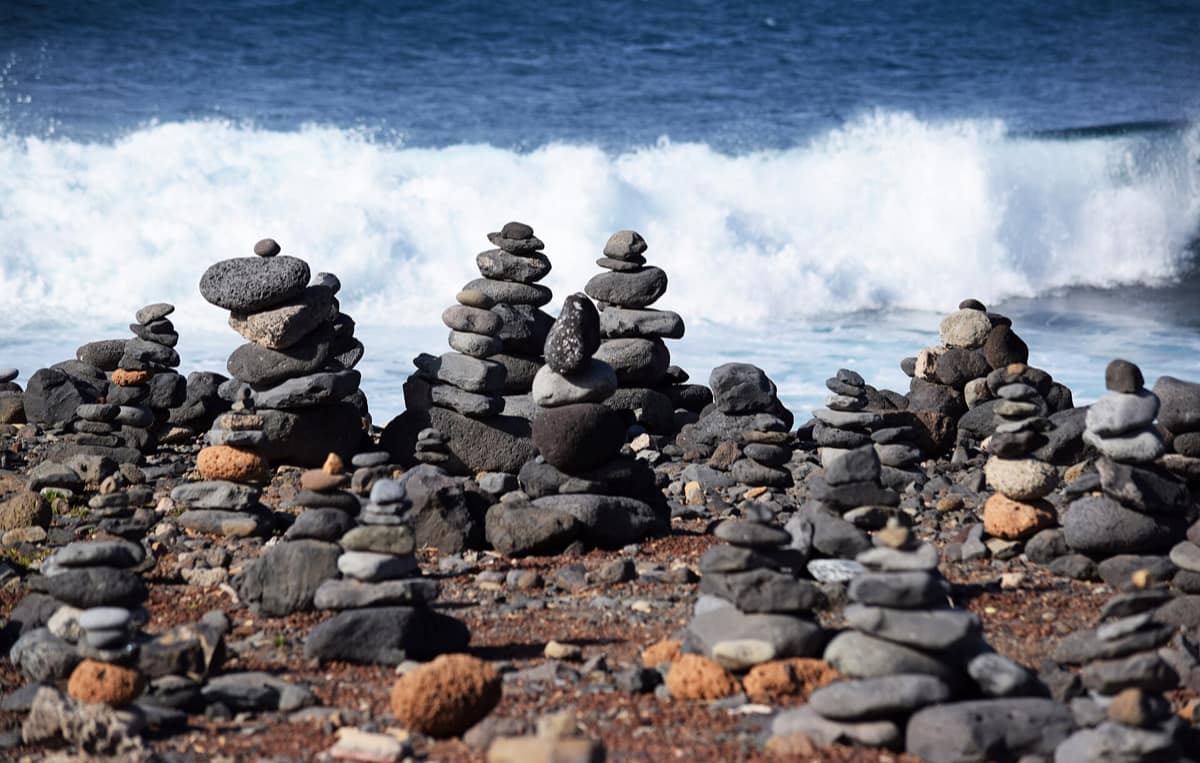
A pebble is a stone the sea has taken clues away from. No sharp edges, no crystal faces, no weathering rind: tumbling erases exactly what you would look at first anywhere else. In exchange it polishes the material and makes it legible — a wet pebble shows its true colour and true translucency far better than a quarry block does.
Start with the beach, not the pebble
This is the shortcut most guides skip. A beach contains roughly what the neighbouring cliffs and rivers put on it, and that shortens the list before any test.
- Chalk coast (Channel, Normandy, Sussex): flint dominates heavily, often as nodules with a white crust. Chalk and limestone as soft pale fragments.
- Granite coast (Brittany, Cornwall, Galicia): granite, white vein quartz, pink feldspar, mica schist.
- Volcanic coast (Iceland, Sicily, the Azores, parts of Scotland): black basalt, sometimes obsidian, sometimes agates and zeolites from gas cavities.
- Limestone coast (Mediterranean, Adriatic): pale limestones that fizz in vinegar, marbles, breccias.
- River mouth: more or less anything the catchment crosses, including rocks carried hundreds of kilometres.
An agate on a Normandy beach would be an anomaly; on a volcanic Scottish beach it is a reasonable expectation.
The six materials that make almost every pebble
Flint. Grey, brown, black or honey-coloured, translucent at thin edges, greasy or waxy lustre. Hardness 7: it scratches glass decisively. Conchoidal, shell-like fracture. Many pebbles keep a patch of cortex, the chalky white rind of the original nodule — the surest sign there is. Vinegar does nothing to flint, but fizzes on the cortex.
Quartz and quartzite. Milky white to colourless, translucent, hardness 7, conchoidal but often granular fracture. Quartzite is a rock: under a loupe you see welded grains. These are the whitest pebbles on a beach, and often the roundest, because they are both hard and tough.
Limestone. Pale, dull, often with visible fossils or grains. Hardness 3: a fingernail nearly marks it, a nail definitely does. It fizzes in vinegar — the test that names it in one second. Limestone pebbles are typically duller, softer and more quickly worn.
Granite. Recognisable with the naked eye: grains of several colours packed together — translucent grey quartz, white or pink feldspar, glittering black mica. It is a rock, and no single hardness test applies to it.
Basalt. Black to very dark grey, dull, very fine-grained. Often peppered with small rounded cavities, the vesicles left by gas escaping from the lava. Heavy for its size. See also the guide to black stones.
Sandstone. Grainy to the touch, like sandpaper. You can see the sand grains, and sometimes lift them with a fingernail. Often beige, ochre or red.
The finds worth the walk
Agate. Translucent, banded in concentric rings, hardness 7, waxy lustre. On a tumbled pebble, wet it: the bands appear. Agate beaches are tied to old lava flows, where escaping gas left cavities that silica later filled. Details on the agate page.
Jasper. Same family as agate, but opaque and often red, brown or green. Hardness 7, waxy lustre, conchoidal fracture.
Fossils. On a limestone or chalk beach: sea urchins, belemnites, ammonites, shells. A regularly domed pebble with a five-rayed pattern is very probably a silicified fossil urchin.
Conglomerates and breccias. Fragments set in a cement: a rock that records an ancient collapse or riverbed.
The false friends
Sea glass. Frosted, satiny, too evenly coloured — bottle green, brown, milky white. No internal structure. A curvature of constant thickness, or a single spherical bubble, marks the bottle. It is also lighter than a flint of the same volume.
Tumbled ceramic. A polished shard of plate often keeps one face smoother than the other, or a trace of shiny glaze in a hollow.
Slag and clinker. Black, glassy, bubbly. Common on beaches near former coal ports, where it was dumped as ballast. Frequently mistaken for obsidian or meteorites; the bubbles give it away.
Tumbled concrete. A grey pebble with angular grains of mixed colours, slightly too regular: the fragments in it are angular where a real sedimentary rock would have rounded them.
Three gestures that are enough in the field
Wet it. A dry pebble lies about its colour and hides its translucency. Seawater will do.
Hold a thin edge to the light. Flint, agate and quartz let light through; limestone, basalt and sandstone do not.
Scratch it with a nail. If it bites, you are below 5.5: limestone, soft sandstone, chalk. If it slides, you are above: flint, quartz, agate, jasper. It is the most useful division on the whole beach, and it also explains why the hard pebbles are the most numerous — the others end up as sand.
Frequently asked questions
What is the most common stone on a beach?
Flint on chalk coasts, quartz and quartzite very nearly everywhere, limestone near limestone coasts. Those are the three materials that best survive tumbling: softer rocks are ground to sand before they ever reach pebble size.
How do I recognise an agate pebble on a beach?
Look for translucency at a thin edge and regular concentric banding. A tumbled agate stays translucent and hints at its bands, especially when wet. It scratches glass. Agate beaches go with volcanic formations, not with chalk coastlines.
How do I tell sea glass from a real stone?
Sea glass has an evenly frosted, satiny surface, often a constant thickness, sometimes a bottle's curvature or a single spherical bubble. It shows no internal structure, no grain, no banding. And it is noticeably lighter than a flint pebble of the same size.