Stones
Rose quartz
Rose quartz is the one variety of quartz that almost never forms good crystals. That failing is precisely what identifies it.
Updated September 8, 2026
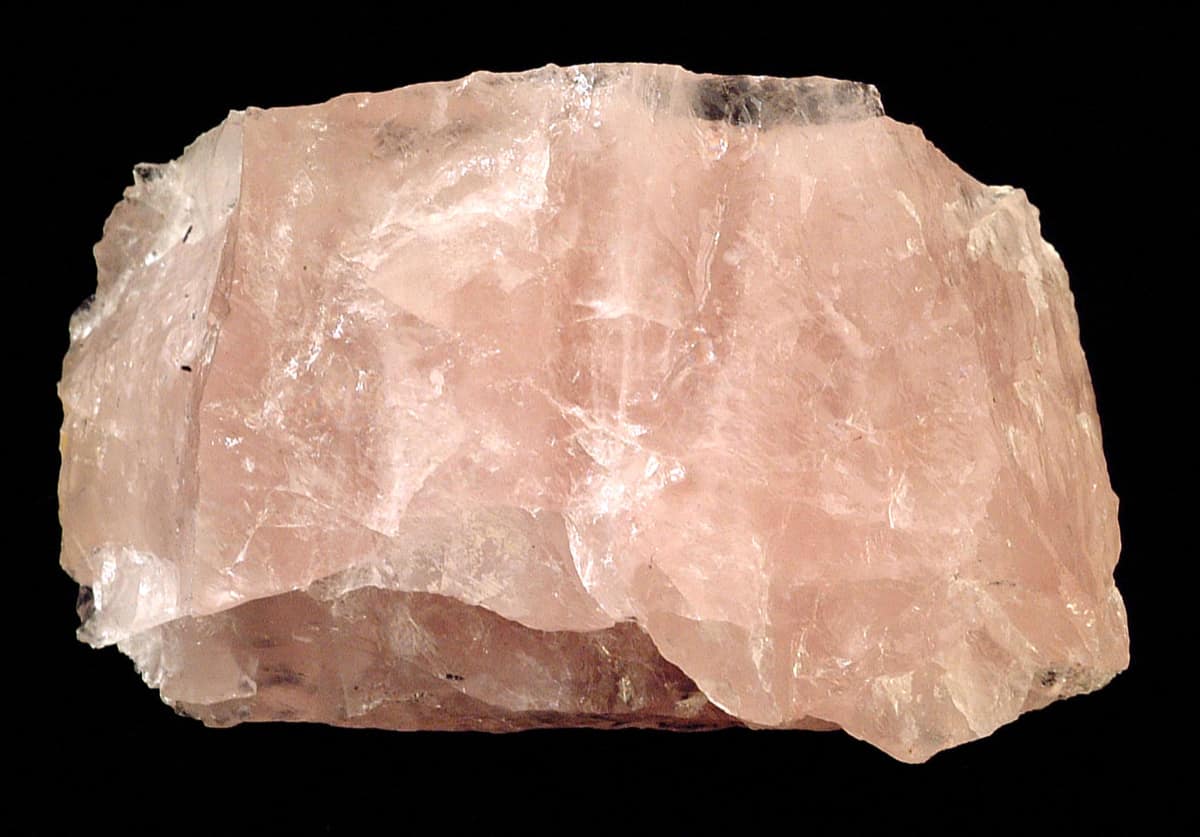
Rose quartz is quartz: same formula, same hardness of 7, same absence of cleavage as rock crystal. What sets it apart from every other quartz variety is that it almost never occurs as crystals. It is found as masses, as veins, as pebbles — and that peculiarity is its best distinguishing mark.
Its identity card
| Property | Value |
|---|---|
| Composition | silicon dioxide, SiO₂ |
| Hardness | 7 |
| Density | 2.65 |
| Lustre | vitreous to slightly greasy |
| Transparency | translucent, never clear |
| Cleavage | none |
| Fracture | conchoidal |
| Streak | white |
Why it is always cloudy
Its colour does not come from an impurity dissolved in the crystal, as in amethyst, but from microscopic mineral fibres scattered through the mass — a borosilicate close to dumortierite, in needles far finer than a hair.
Two consequences follow directly, and they are the two things to look at:
It is milky. Those fibres scatter light. A perfectly clear rose quartz essentially does not exist; if it is clear, suspect glass.
It does not crystallise well. The inclusions disrupt growth. That is why you practically never see a rose quartz point, while amethyst and rock crystal points are everywhere. A well-formed, transparent, regular pink point is almost always dyed quartz or resin.
When the fibres happen to be regularly aligned, a polished sphere sometimes shows a six-rayed star under a point light: that is asterism, and it is a very good sign of authenticity.
The five confusions
Pink calcite. Hardness 3, scratched by a coin, and above all: it fizzes in vinegar. It also cleaves into rhombohedra with bright faces, where rose quartz breaks in curved shells. Two tests, no ambiguity.
Rhodochrosite. Vivid pink, often in very recognisable concentric white-and-pink bands. It is a manganese carbonate: hardness 3.5 to 4, and it fizzes in vinegar like calcite. Much softer, much more strongly coloured.
Rhodonite. Pink to red, almost always crossed by black veins and patches of manganese oxide — a pattern that does not mislead. Hardness 5.5 to 6.5: a nail bites it with difficulty, glass barely scratches it, but it does not decisively scratch glass the way quartz does.
Pink glass. Spherical bubbles, too-uniform colour, warm to the touch, scratched by quartz. The touch test is surprisingly reliable: hold the stone against your lip, and quartz stays cool markedly longer.
Dyed quartz. Porous milky white quartz can be coloured artificially. The dye concentrates in fractures and permeable zones: look for lines of stronger colour along cracks, an over-vivid tint, or colour that comes off slightly on a damp cloth.
Where it comes from
It forms in pegmatites, the very coarse-grained rocks that crystallise at the end of a granitic magma's cooling. The major deposits are in Brazil (Minas Gerais), Madagascar, Namibia, South Africa and South Dakota. In France it turns up in the pegmatites of the Massif Central and the Limousin, in rarely spectacular masses.
Because it is massive rather than crystallised, it is nearly always sold cut, polished or tumbled — seldom as it came out of the ground.
Its reputation
Rose quartz has long been associated with affection and gentleness, and it is today the biggest seller in crystal healing. That is a cultural tradition, old and well documented ethnographically, with no basis in the mineral's physical properties and no medical standing.
At a glance
Pink, cloudy, massive, without crystal faces, hardness 7, indifferent to vinegar: rose quartz. Pink and fizzing: a carbonate. Pink with black veins: rhodonite. Pink, clear and warm: glass. The general method does the rest.
Frequently asked questions
How do I recognise real rose quartz?
It is translucent but cloudy, never perfectly clear, and its mass is crossed by microfractures that catch the light. It scratches glass effortlessly and stays cool to the touch. A decidedly transparent pink stone, or one a nail can scratch, is not rose quartz.
Does rose quartz lose its colour?
Yes, in direct sunlight. Its colour comes from microscopic fibrous inclusions that are sensitive to ultraviolet light and heat. A pebble left on a south-facing windowsill fades within a season or two, with no way back.
Why does rose quartz almost never form points?
Because its colour comes from microscopic mineral fibres scattered through the mass, and those get in the way of a well-formed crystal growing. Rose quartz therefore turns up as compact masses, veins and pebbles. The rare well-formed pink crystals, from Minas Gerais in Brazil, owe their colour to a different mechanism and are collectors' pieces.